
Hydrogen peroxide: grades, uses and safe storage (35%, 40%, 50%, 60%)
35%, 40%, 50% or 60%? What hydrogen peroxide is used for, which tank materials are safe, how to keep it stable in Saudi summer heat, and what to ask for when buying.
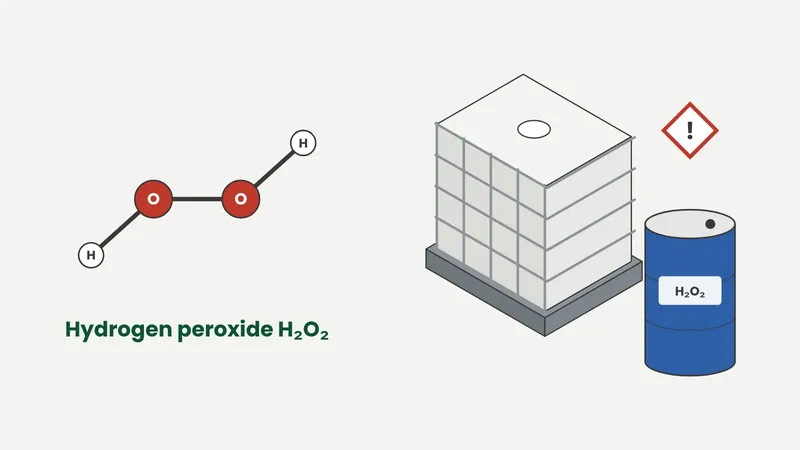
Short answer: hydrogen peroxide (H₂O₂, CAS 7722-84-1) is a clear liquid oxidant that breaks down to water and oxygen, leaving no salt or chlorine residue. Industry buys it as a stabilised water solution, usually 35% to 60%. It is used for bleaching pulp and textiles, destroying cyanide in gold plants, treating water and wastewater, and in chemical synthesis. It is not flammable, but it is a strong oxidiser: it must be kept clean, vented and cool. In a Saudi summer, keeping it cool takes planning.
Grades and concentrations
| Grade | Typical concentrations | Where it is used |
|---|---|---|
| Technical (stabilised) | 35%, 40%, 50%, 60% | Bleaching, mining, water treatment, chemical processing |
| Food or aseptic grade | 35%, 50% | Sterilising cartons and bottles on aseptic filling lines |
| Electronic or semiconductor grade | about 30–31% | Wafer cleaning; impurities held to ppb levels |
| Reagent or laboratory | 30% | Analysis and laboratory work |
Technical grades contain small amounts of stabilisers, typically tin and phosphate compounds, that slow decomposition in storage. Food and electronic grades restrict which stabilisers are used and in what amounts, so give your supplier the end use, not just the strength.
Nord Chemicals holds technical, stabilised hydrogen peroxide 40% in stock in Dammam, and supplies 35%, 50% and 60% to order. The 40% grade sits between the 35% and 50% columns below. See the hydrogen peroxide product page.
Key properties
| Property | 35% | 50% | 60% |
|---|---|---|---|
| Density at 20 °C | 1.13 g/mL | 1.20 g/mL | 1.24 g/mL |
| Boiling point | 108 °C | 114 °C | 119 °C |
| Freezing point | −33 °C | −52 °C | −56 °C |
| Active oxygen | 16.5% | 23.5% | 28.2% |
| Transport (UN) | UN 2014, Class 5.1 (8) | UN 2014, Class 5.1 (8) | UN 2014, Class 5.1 (8) |
Values are typical figures published by the major producers. Solutions of 8–20% move as UN 2984, and solutions above 60% move as UN 2015. Check the SDS and certificate of analysis for the exact grade you buy.
How to read the table. Hydrogen peroxide is priced by weight of solution but works by its H₂O₂ content. A tonne of 50% gives about 43% more H₂O₂ than a tonne of 35%, at a lower freight cost per unit of active product. Plants with good storage usually buy 50% and dilute on site. Smaller users usually stay with 35%, which is easier to handle and can be stored in HDPE.
What it is used for
- Pulp, paper and recycled fibre: brightening mechanical and recycled pulp and de-inking without chlorine.
- Textiles: bleaching cotton and blends before dyeing. Peroxide is the standard bleach for cotton because it leaves no chlorinated by-products.
- Mining: destroying free and weak-acid-dissociable cyanide in gold plant tailings, where it oxidises cyanide to cyanate. It is also used as an oxidant in some leach circuits. See our article on flotation reagents for gold and copper.
- Water and wastewater: removing hydrogen sulfide and odour in sewers and lift stations, and oxidising iron, manganese and organics. It is the oxidant in advanced oxidation (with UV or ozone) and in Fenton treatment (with an iron catalyst). More in water treatment chemicals explained.
- Food and beverage: sterilising packaging on aseptic lines (food grade only) and sanitising surfaces in CIP programmes. See CIP cleaning chemicals.
- Chemical synthesis: making peracetic acid, sodium percarbonate and perborate, epoxides, and propylene oxide by the HPPO route.
- Electronics: cleaning silicon wafers in the semiconductor industry (electronic grade only).
Safe storage and handling
Hydrogen peroxide is always decomposing slowly into water and oxygen, and the reaction gives off heat. Good storage keeps that reaction slow. Three things speed it up: heat, contamination and confinement.
1. Never confine it. Drums, IBCs and tanks must have vented caps or vents, and any pipe section that can be shut at both ends needs a pressure relief. A blocked vent turns slow decomposition into a pressure burst.
2. Keep it clean. Rust, dirt, copper, brass, alkalis and organic matter all catalyse decomposition. Once product has been taken out of a container, never pour it back. Use dedicated, clean pumps, hoses and measuring jugs.
3. Use the right materials.
| Material | Suitable? |
|---|---|
| Passivated stainless steel 304L / 316L | Yes, standard for tanks and pipework |
| High-purity aluminium (99.5%+) | Yes, for many grades; confirm with the supplier |
| HDPE | Yes, up to 50%; above that it can crack |
| PVDF, PTFE, glass | Yes, for fittings, seals and linings |
| Copper, brass, mild steel, galvanised steel | No: they cause rapid decomposition |
| Wood, paper, cloth, rubber not rated for peroxide | No: keep combustibles away |
4. Keep it cool and shaded. Decomposition roughly doubles with every 10 °C or so of temperature rise. At about 20 °C, a good stabilised grade typically loses less than 2% of its strength a year. Producers advise that a bulk tank reading about 40 °C may be decomposing too fast and should be cooled. In Riyadh or Dammam summers, a drum standing in the sun can pass that, so:
- Store drums and IBCs indoors or under a roof, out of direct sun, with air movement.
- For bulk, use a shade roof, light-coloured tanks, a temperature gauge with a high-temperature alarm, and a water deluge or cooling plan.
- Rotate stock: first in, first out, and avoid buying more than you will use within a few months in summer.
- Keep tanks inside a bund sized for the full contents, and keep fuels, solvents and combustibles out of the same store.
5. Protect people. Concentrated hydrogen peroxide burns skin and can cause permanent eye damage, sometimes with delayed effect. Wear chemical splash goggles with a face shield, PVC, neoprene or nitrile gloves, and an apron or chemical suit when decanting. Have an eyewash and safety shower within reach. The common occupational exposure limit is 1 ppm (8-hour average).
6. Spills. Dilute with plenty of water. Do not soak spills up with sawdust, rags or other combustible absorbents, because these can ignite as they dry. Wash clothing that has been splashed straight away for the same reason.
Warning signs of runaway decomposition: a drum that is bulging or hot to the touch, steady gas bubbling, or a tank temperature that keeps rising. Clear the area, cool the container with water from a distance, and follow the emergency procedure in the SDS.
Always follow the product's SDS. This article is general guidance, not a substitute for it.
Buying hydrogen peroxide in Saudi Arabia
When you ask for a price, include:
- Concentration (35, 40, 50 or 60%) and grade (technical, food or electronic), with the end use.
- Monthly volume and pack: vented 30 kg drums, 1,000 L IBCs, or bulk tanker.
- Documents: SDS, a certificate of analysis for each batch, and any approvals your industry needs.
- Delivery and storage: whether your site can receive in summer heat, and how long the product will be stored.
Some oxidisers and other controlled chemicals need import or storage permits in Saudi Arabia, so check the paperwork before the first order. Our guide to buying industrial chemicals in Saudi Arabia explains the documents and permits involved.
Nord Chemicals, part of Nordinfini, holds hydrogen peroxide 40% in stock in Dammam and supplies, blends and repacks commodity and specialty chemicals from Dammam for 14 industries across Saudi Arabia and the GCC, with a safety data sheet for every product. Find products by industry in the chemical finder or request a quote.
Frequently asked questions
Is hydrogen peroxide flammable? No. It does not burn, but it releases oxygen as it decomposes. That oxygen can make combustible materials ignite and burn fiercely, so keep it away from fuels, solvents, wood and paper.
35% or 50%: which should I buy? It depends on volume and storage. 50% gives more active product per tonne and per truck, but it needs stainless steel or aluminium for bulk storage and more careful handling. 35% suits smaller users, can be stored in HDPE, and is the usual strength for food and sanitising uses.
How long does it keep? Stabilised technical grades stored cool, at about 20 °C, typically lose less than 2% a year. Heat, sunlight and contamination shorten that considerably.
Can I dilute it on site? Yes, by adding it to clean, demineralised or low-hardness water in compatible equipment. Always add peroxide to water, not water to peroxide, and do not dilute with water that contains iron, manganese or chlorine.
Sources
- Evonik Active Oxygens, Hydrogen peroxide: physico-chemical properties, storage, and safety and handling.
- Solvay, Hydrogen peroxide safety and handling and Materials of construction for the storage of hydrogen peroxide technical data sheets.
- PubChem, Hydrogen peroxide (CID 784).
- UN Recommendations on the Transport of Dangerous Goods (UN 2014, UN 2015, UN 2984).
Need this chemical in Saudi Arabia or the GCC?
Nord Chemicals supplies, manufactures and blends industrial chemicals from Dammam, for nine industries across Saudi Arabia and the GCC.
See Nord ChemicalsRelated articles
Flotation reagents for gold and copper: xanthates, frothers, depressants and activators
How a flotation circuit uses collectors such as PAX and SIBX, frothers such as MIBC, depressants, activators and pH modifiers, and how to choose between them.
Water treatment chemicals: coagulants, flocculants, antiscalants and biocides explained
Which chemical does which job in a water or wastewater plant: clarification, RO membrane protection, disinfection, boilers and cooling towers, with what to check before you buy.
Nitric acid: concentrations, industrial uses and safe storage
From fertilisers to stainless steel passivation: what nitric acid is used for, the common commercial concentrations, and how to store and handle a strong oxidising acid.