
Sodium hypochlorite: strength, storage in hot weather and how to dose it
Why bleach loses strength, how heat and concentration speed it up, what to store it in, and a simple way to work out the dose for water chlorination.
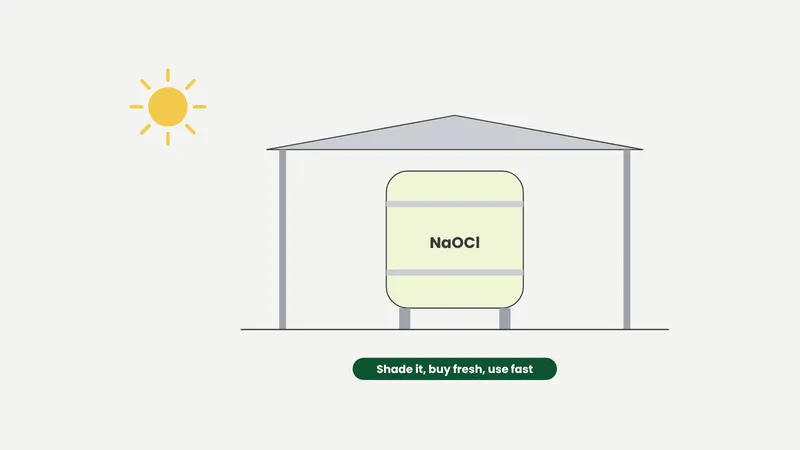
Short answer: sodium hypochlorite (NaOCl, bleach, CAS 7681-52-9) is the most common way to chlorinate water and disinfect surfaces. Industrial grades carry about 10–15% available chlorine. It starts losing strength from the day it is made, and heat and high concentration make it decompose much faster, so in Saudi Arabia it should be bought fresh, stored shaded and used within weeks, not months.
Strength: what the numbers mean
Bleach strength is usually stated as available chlorine, either as % by weight or as grams per litre (g/L). A product sold as "12%" may mean 12% w/v, which is 120 g of available chlorine per litre. Ask which basis your supplier uses, and dose from the figure on the certificate of analysis, not the label.
Why it loses strength
Hypochlorite slowly breaks down into salt and sodium chlorate, with a little oxygen. Three things speed this up:
- Heat. Studies of commercial bleach show the decomposition rate rising by roughly 2 to 4 times for every 10 °C increase in storage temperature. A tank at 45 °C in July can lose strength many times faster than the same tank at 25 °C.
- Concentration. Stronger bleach decomposes faster: a 15% solution can decompose about 10 times faster than a 5% solution at the same temperature. Diluting soon after delivery slows the loss.
- Metals and light. Traces of nickel, cobalt, copper and iron catalyse decomposition, and sunlight speeds it up.
The by-product matters as well as the lost strength: chlorate builds up in old, hot bleach and ends up in the treated water, where drinking water rules limit it. Fresh bleach means less chlorate per dose.
Storage that works in a hot climate
- Store in the shade or indoors, out of direct sun, in a ventilated area.
- Use HDPE, FRP or PVC tanks and fittings. Avoid stainless steel and other metals, which corrode and catalyse decomposition.
- Buy little and often. Size deliveries to use the product within a few weeks in summer.
- If your dosing allows, dilute on arrival with softened or low-hardness water to slow decomposition.
- Vent tanks, keep caps closed, and keep the store clean of metal swarf and dirt.
Safety: the two mixtures to never make
- Never mix with acids. Acid releases chlorine gas. Keep bleach well away from hydrochloric acid, acid cleaners, ferric chloride and alum.
- Never mix with ammonia or ammonium products. This forms toxic chloramines.
Hypochlorite is corrosive to skin and eyes: wear goggles or a face shield, chemical gloves and an apron, and keep an eyewash close. For transport it is UN 1791, Class 8. Always follow the product's SDS.
How to work out the dose
The basic calculation: dose (mg/L) × flow (m³) = grams of chlorine needed. One mg/L in one cubic metre is one gram.
Example: you want to dose 2 mg/L into a tank of 50 m³ using bleach of 120 g/L available chlorine.
- Chlorine needed: 2 × 50 = 100 g.
- Bleach needed: 100 ÷ 120 = 0.83 L.
Then measure the free chlorine residual after the contact time and adjust. For drinking water, the WHO guidance is a free chlorine residual of at least 0.5 mg/L after at least 30 minutes contact at pH below 8, and the maximum guideline value is 5 mg/L. Local regulations and your water authority's targets apply.
Sodium or calcium hypochlorite?
Liquid sodium hypochlorite is easy to pump and dose but loses strength in storage. Solid calcium hypochlorite keeps much longer and is easier to transport to remote sites.
Buying sodium hypochlorite in Saudi Arabia
Nord Chemicals, part of Nordinfini, holds sodium hypochlorite in stock in Dammam for quick delivery across Saudi Arabia and the GCC, with a safety data sheet and a certificate of analysis for each batch. See everything we supply for water treatment, see the full in-stock list, or request a quote with the grade, quantity, pack and delivery city.
Sources
- The Chlorine Institute / bleach producers, Bleach storage guidelines for end users (temperature and concentration effects).
- Adam, Fabian and Gordon, Hypochlorite ion decomposition: effects of temperature, ionic strength and chloride ion, Inorganic Chemistry (1999).
- WHO, Guidelines for Drinking-water Quality (chlorine).
Need this chemical in Saudi Arabia or the GCC?
Nord Chemicals supplies, manufactures and blends industrial chemicals from Dammam, for nine industries across Saudi Arabia and the GCC.
See Nord Chemicals Ask on WhatsAppRelated articles
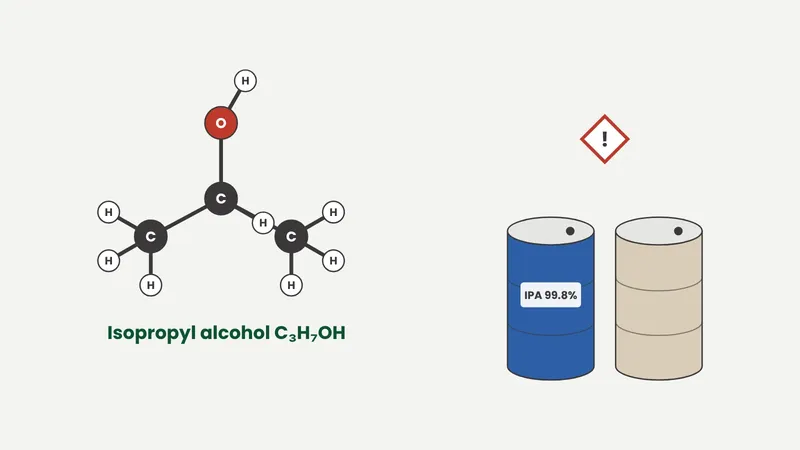
Isopropyl alcohol (IPA): pure grade, IPA 70% and how each is used
Pure (99.8%+) IPA, USP grade or a 70% solution: which isopropyl alcohol to buy for cleaning, electronics, coatings, pharma and disinfection, and how to store it safely.
Caustic soda (sodium hydroxide): prills, flakes or lye, uses and safe handling
Prills, flakes or 50% lye: which form of caustic soda to buy, how to make up a solution safely, where it is used, and what to watch in storage.
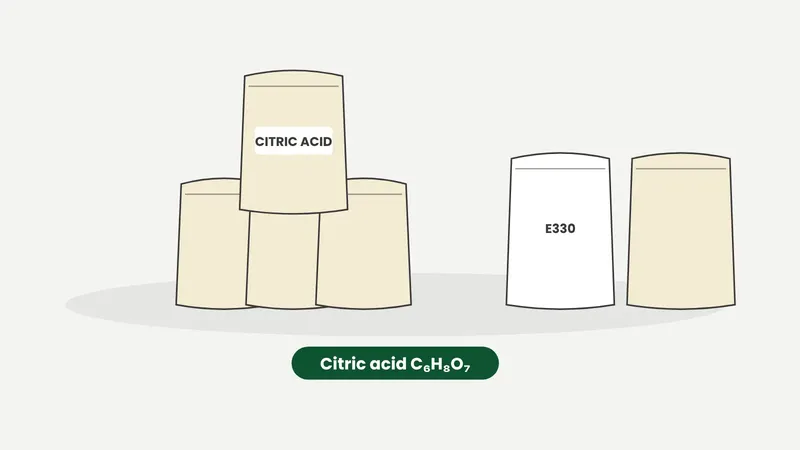
Citric acid: anhydrous vs monohydrate, grades and industrial uses
Anhydrous or monohydrate, food or technical grade: how to choose citric acid, where it is used from beverages to descaling and stainless steel passivation, and how to store it.