
Commercial carpet in Saudi Arabia: a specification checklist
Use class, construction, pile weight, fibre, backing, fire and installation: the ten lines every commercial carpet specification in the Kingdom should cover.
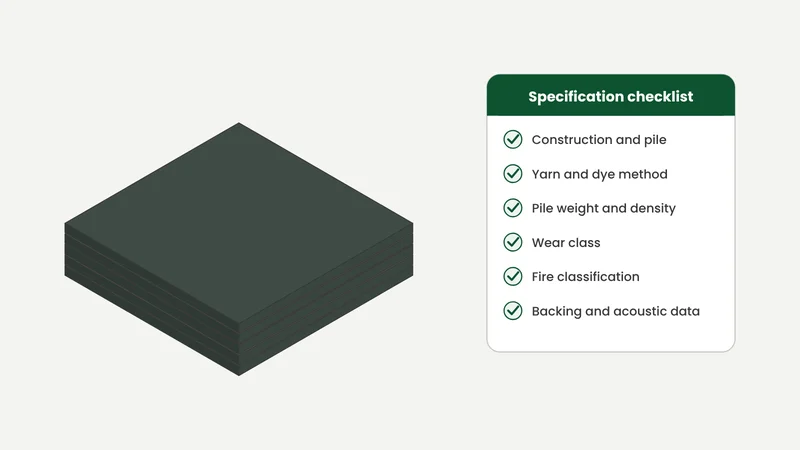
Short answer: a good carpet specification fixes what the carpet must do (use class, fire, castor rating, acoustics), what it is made of (construction, fibre, pile weight, backing) and how it is installed. Leave out any one of them and you invite a cheaper carpet that only looks the same on the sample board.
The ten-point checklist
1. Use class (EN 1307). Commercial carpets are classed 31 (moderate), 32 (general) or 33 (heavy). Offices usually need 32 or 33; corridors, lobbies and retail need 33.
2. Construction. Carpet tiles, machine-tufted broadloom, Axminster or hand-tufted. Tiles suit offices and raised floors; Axminster suits patterned hotel and mosque floors; hand-tufted suits custom rugs and majlis rooms.
3. Pile type. Loop for durability in offices, cut for comfort and luxury, cut-and-loop for pattern. (Cut vs loop explained.)
4. Pile weight and density. State a minimum pile weight in g/m² (or oz/yd²) and, for tufted carpet, the gauge and stitch rate. This stops lighter substitutes.
5. Fibre. Solution-dyed nylon is the commercial benchmark: colourfast and cleanable with strong chemicals. Wool or 80/20 wool-nylon for premium woven carpets.
6. Backing. For tiles, a dimensionally stable backing that lies flat in air-conditioned buildings (bitumen, PVC-free or felt backings). For broadloom, the secondary backing and whether an underlay is used.
7. Castor chair suitability. Where office chairs roll, require a castor chair rating (EN 985).
8. Fire performance. Interior floor finishes in Saudi Arabia are governed by the Saudi Fire Code (SBC 801) and the project's civil defence requirements. Specifications in the region commonly ask for one or more of: ASTM E648 / NFPA 253 critical radiant flux (Class I or II), the ASTM D2859 "pill test", and EN 13501-1 (for example Bfl-s1). Ask for the actual test reports for the exact product.
9. Installation. Tiles on raised floors must be laid with a tackifier (release adhesive) so panels can be lifted. State the laying pattern (monolithic, quarter-turn, ashlar), the subfloor preparation and the attic stock (spare tiles kept for future replacements).
10. Submittal. Data sheet, use class certificate, fire test reports, maintenance guide, sample and, where relevant, an EPD for green building credits.
A sample clause
Carpet tiles, 50 × 50 cm, loop pile, solution-dyed nylon, minimum pile weight [___] g/m², EN 1307 use class 33, castor chair suitable to EN 985, fire performance to [project requirement], laid quarter-turn on tackifier over the raised access floor; supply 3% attic stock.
Where Nord Floors fits
We produce our own carpet qualities (tiles, machine-tufted broadloom, Axminster and hand-tufted) and install them across the Kingdom, often on top of the raised floors we make, so one team answers for the whole floor. Build your specification in the carpet selector and copy the clause into your documents.
Sources
- EN 1307, Textile floor coverings: classification (via Centexbel and BSI summaries).
- ASTM E648 / NFPA 253, ASTM D2859, EN 13501-1, EN 985 (test method titles).
- Saudi Building Code SBC 801 (Saudi Fire Code).
Specify your carpet in a few taps
Pick the room, traffic and look. We suggest the construction, pile and quality, and give you the spec text.
Open the carpet selectorRelated articles

Perforated panels and CRAC airflow: how many do you really need?
Too few perforated panels starve the racks; too many waste cold air. Here is how to size them from the cooling units and the IT load, step by step.
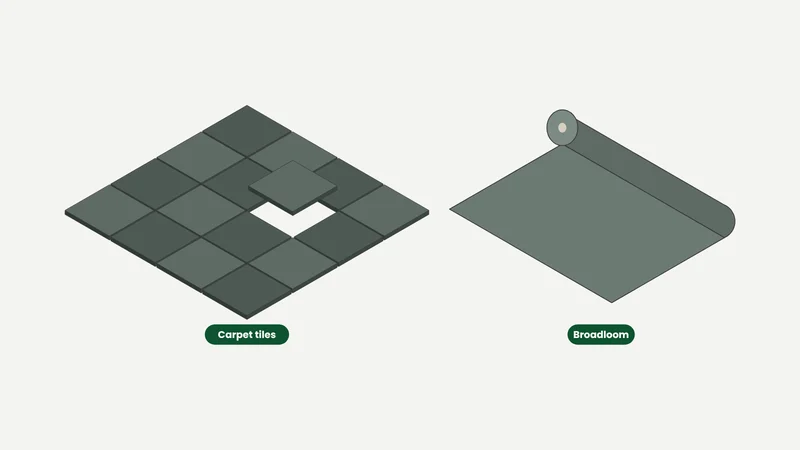
Carpet tiles or broadloom? Choosing office carpet for a raised floor
On a raised access floor the answer is usually carpet tiles — but not always. How access, wear, acoustics and design decide between tiles, broadloom, Axminster and hand-tufted.
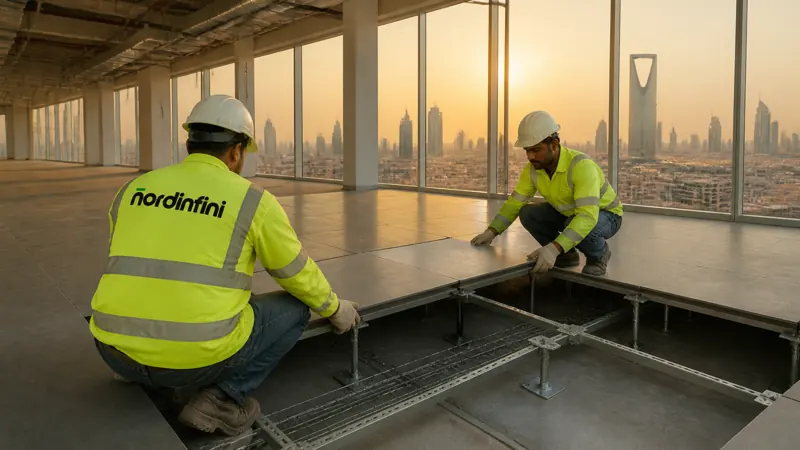
How to choose a raised access floor: a practical guide for Saudi projects
Panel type, load grade, finish and finished floor height — the four decisions that decide whether a raised floor works for its whole life, and how to get each one right.