
Hand-knotted, hand-tufted, Axminster, Wilton or tufted? Carpet constructions explained
Five ways to make a carpet, how each one works, what it costs you in time and money, and which belongs in a hotel, a mosque, an office or a palace.
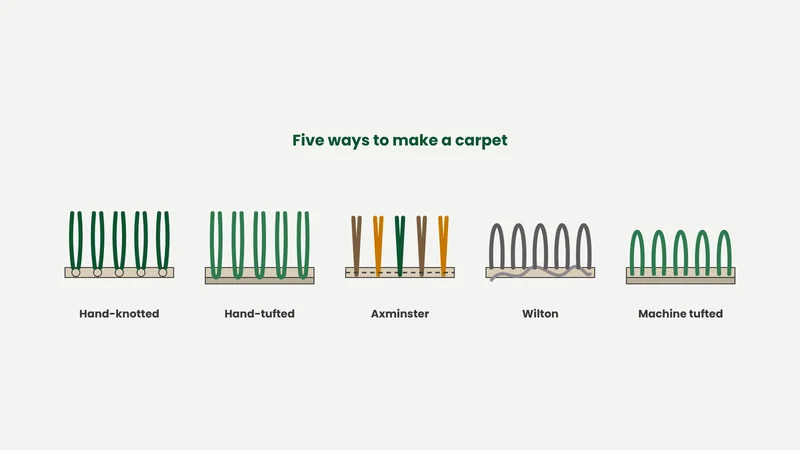
Short answer: hand-knotted is the slowest and finest; hand-tufted gives unlimited custom design at a sensible cost; Axminster is the woven carpet for patterned hotel and mosque floors; Wilton is the dense woven carpet for plainer, very hard-wearing floors; machine-tufted broadloom and carpet tiles cover most offices.
Hand-knotted
How it is made: on a vertical loom strung with warp threads. The weaver ties each pile knot by hand around one or two warps, then beats in weft threads to lock a row. The two main knots are the Persian (asymmetrical) knot, tied around one warp, which allows fine curves, and the Turkish (symmetrical) knot, tied around two, which is sturdy.
Quality marker: knots per square inch (KPSI). Higher KPSI allows finer detail and means more weaving time.
Best for: heirloom rugs, palaces and residences. Trade-off: time and cost, and size is limited by the loom.
Hand-tufted
How it is made: a tufting gun shoots yarn through a stretched cotton cloth printed with the design; the back is latexed and covered with a second cloth; the face is sheared and carved.
Quality markers: yarn, pile weight and density, latex and backing quality, carving.
Best for: custom carpets and rugs in any design, colour count, size or shape: majlis rooms, hotel lobbies, executive floors. Trade-off: it relies on latex and backing rather than a woven structure, so quality of materials matters.
Axminster (woven)
How it is made: on a power loom where each tuft is inserted individually as the carpet is woven, then locked into a woven backing. Because every tuft is placed on its own, almost any number of colours and any pattern can be woven.
Quality markers: pitch (tufts per 27 inches across) and rows (tufts per inch along), yarn (often 80% wool / 20% nylon) and pile height.
Best for: hotel corridors and ballrooms, mosques (saff-pattern carpets), palaces and casinos: anywhere a rich pattern meets heavy traffic.
Wilton (woven)
How it is made: continuous yarns run through the woven backing and are raised into pile only where a colour is needed; the hidden yarns add body. The colour count is more limited than Axminster.
Best for: plain or lightly patterned floors that must take very heavy traffic and look good for many years.
Machine-tufted (broadloom and tiles)
How it is made: rows of needles punch yarn through a primary backing at speed; latex and a secondary backing lock the tufts. Patterns come from yarn colours, cut and loop combinations, or digital printing.
Quality markers: gauge and stitch rate (which set tuft density), pile weight, fibre (solution-dyed nylon is the commercial benchmark) and the EN 1307 use class.
Best for: offices (carpet tiles on raised floors), hotel rooms, schools, most commercial interiors.
How to choose
| If you need… | Choose |
|---|---|
| A unique heirloom rug | Hand-knotted |
| A custom design in any shape, at sensible cost | Hand-tufted |
| A rich pattern in heavy traffic (hotel, mosque) | Axminster |
| A plain, extremely durable woven floor | Wilton |
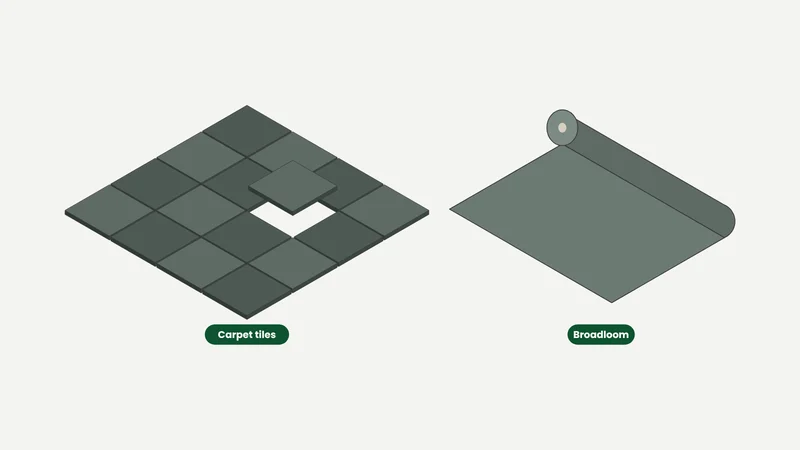
| Office floors you can lift and replace tile by tile | Carpet tiles |
| Wall-to-wall comfort at the best value | Machine-tufted broadloom |
We produce carpet tiles, machine-tufted broadloom, Axminster and hand-tufted carpets in our own qualities. The carpet selector points you to the right one for your room. More terms in our glossary.
Sources
- EN 1307, Textile floor coverings: classification.
- Industry practice for hand-knotted, hand-tufted, Axminster, Wilton and tufted carpet manufacture.
Specify your carpet in a few taps
Pick the room, traffic and look. We suggest the construction, pile and quality, and give you the spec text.
Open the carpet selectorRelated articles

Perforated panels and CRAC airflow: how many do you really need?
Too few perforated panels starve the racks; too many waste cold air. Here is how to size them from the cooling units and the IT load, step by step.
Carpet tiles or broadloom? Choosing office carpet for a raised floor
On a raised access floor the answer is usually carpet tiles — but not always. How access, wear, acoustics and design decide between tiles, broadloom, Axminster and hand-tufted.
How to choose a raised access floor: a practical guide for Saudi projects
Panel type, load grade, finish and finished floor height — the four decisions that decide whether a raised floor works for its whole life, and how to get each one right.