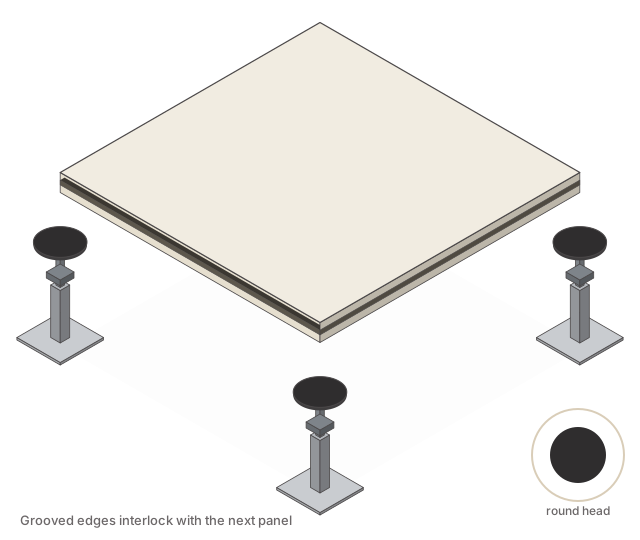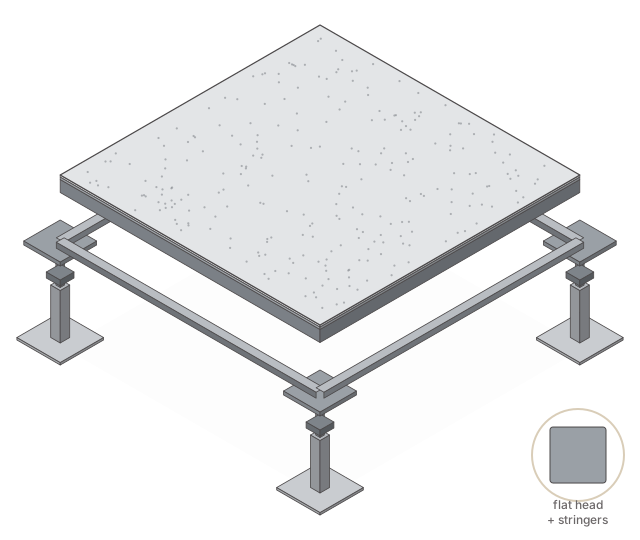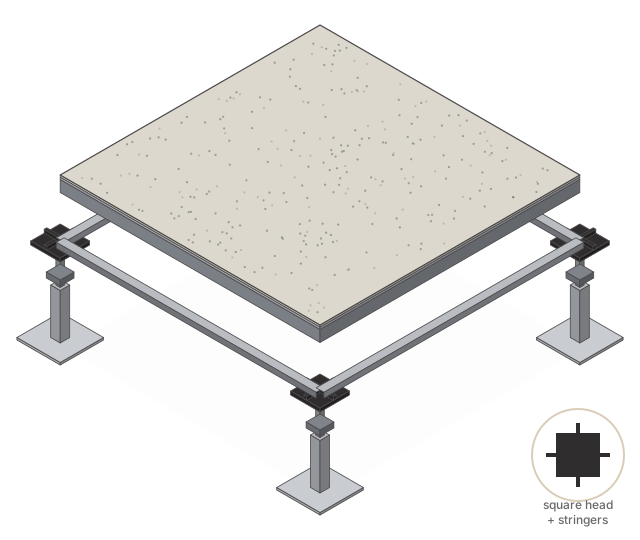
nSteelCement Series
nSteelCement is our main raised access floor: a bare steel cementitious panel made in Dammam. Carpet tiles, LVT and SPC go straight on top; marble, stone, porcelain and parquet go on a plywood, cement board or fibreboard layer. It suits offices, banks, schools and showrooms, with concentrated loads from 3.7 to 11.1 kN.
Overview
Steel sheets welded to a formed steel bottom pan, filled with a lightweight cementitious core and coated against corrosion inside and out. The result is a solid, quiet, non-combustible floor that installs quickly and stays level, with full access to the services below.
Features
- Integrated expansion gasket in the pedestal head keeps a small, even gap between panels, so the floor does not squeak.
- Four-corner screw fixing for extra rigidity, with easy access to the void.
- Panel and pedestal engineered together to remove wobble and poor installs.
- Takes every finish: carpet, LVT and SPC directly; marble, stone, porcelain and parquet on a board layer.
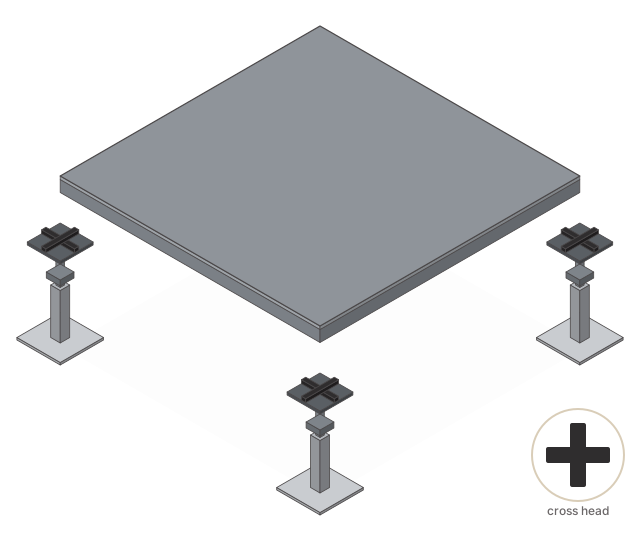
Illustration. Cross head pedestals.
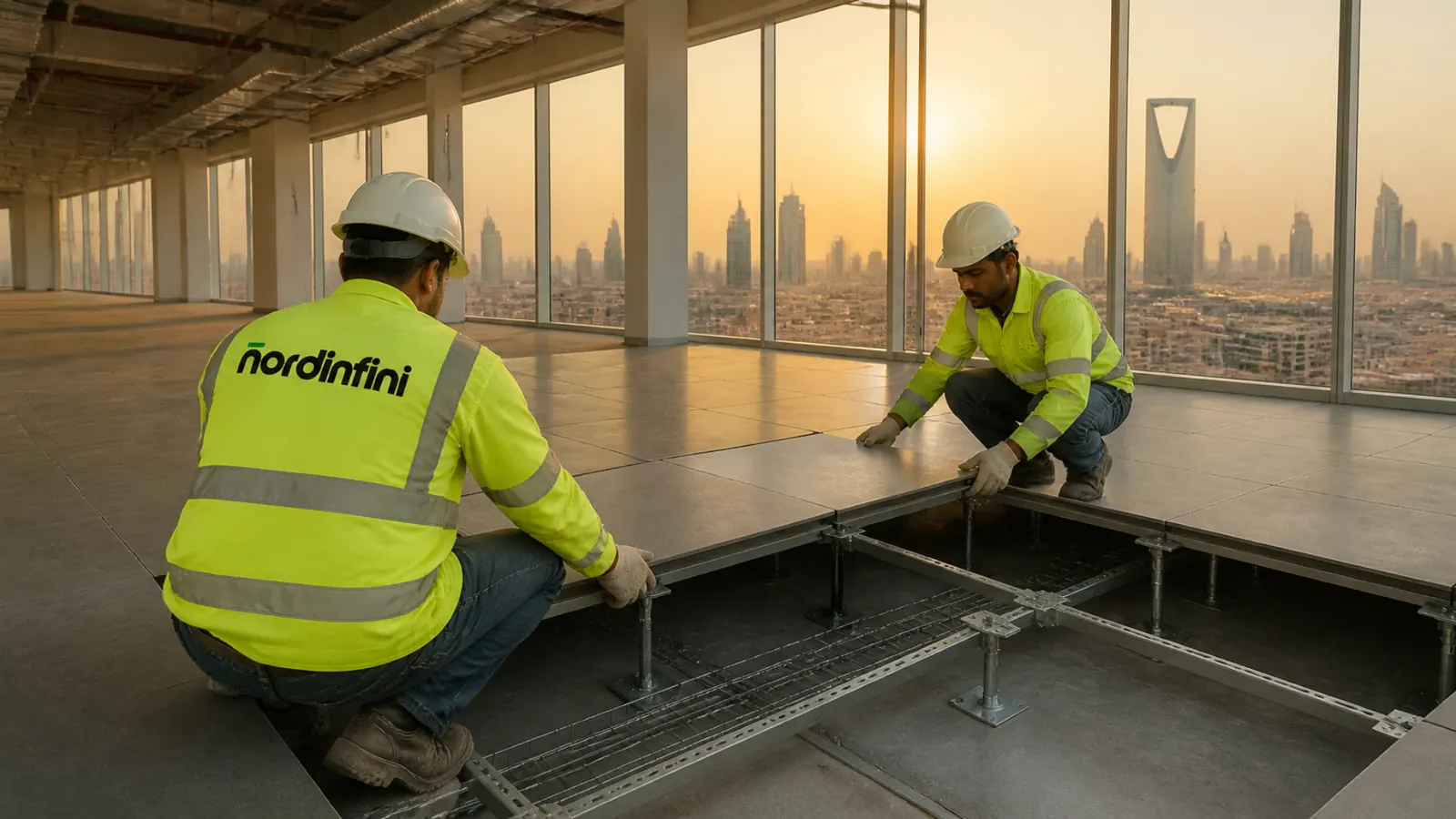
In an office tower. nSteelCement under carpet tiles in a high-rise office: the standard Saudi office floor. Illustration.
Specification
| Panel size | 600 × 600 mm |
|---|---|
| Bare panel thickness | 33 mm |
| Weight | approx. 13–20 kg |
| Core | Cementitious compound in a welded steel shell |
| Finished floor height | 80–2000 mm |
| Squareness | 0.75 mm max |
| Flatness | diagonal 1.0 mm max, edge 0.6 mm max |
| Twist | 1.0 mm max |
| Fire | Non-combustible (ASTM E136, BS 476-4), Class A (ASTM E84), A1 (EN 13501) |
| Acoustic | IIC 58 (ASTM E492-09) |
| Pedestal | Cross head, galvanised steel |
Finishes
Carpet tiles, LVT and SPC directly. Marble, stone, porcelain and parquet go on a plywood, cement board or fibreboard layer fixed to the panels: our standard build-up for hard finishes. Where the finish must be bonded straight to the panel, see nGroove (premium).
Understructure
Stringerless up to 600 mm FFH, with chemical (adhesive) anchoring. Above 600 mm: stringers and mechanical anchoring.
Applications
nSteelCement load grades
| Grade | Concentrated | Impact | Ultimate | Uniform | Rolling, 10 passes | Rolling, 10,000 passes |
|---|---|---|---|---|---|---|
| SC370 | 3.7 kN | 0.67 | 10.8 kN | 19.8 kN/م² | 3.0 kN | 2.2 kN |
| SC450 | 4.5 kN | 0.67 | 13.5 kN | 23.3 kN/م² | 3.6 kN | 3.0 kN |
| SC560 | 5.6 kN | 0.67 | 16.8 kN | 33.1 kN/م² | 4.5 kN | 3.6 kN |
| SC680 | 6.8 kN | 0.67 | 20.1 kN | 42.6 kN/م² | 5.6 kN | 4.5 kN |
| SC890 | 8.9 kN | 0.67 | 26.7 kN | 49.9 kN/م² | 6.7 kN | 5.6 kN |
| SC1110 | 11.1 kN | 0.67 | 33.3 kN | 58.3 kN/م² | 8.9 kN | 6.7 kN |
Recommended minimum for offices: the 450 grade (4.5 kN). For MEWP access: 680 (6.8 kN) and above. Tested to CISCA Recommended Test Procedures for Access Floors.
Documents
The nSteelCement data sheet is in Downloads. Ask for the rest with your quotation or submittal pack.
Questions about nSteelCement
Why does Nord Floors recommend 4.5 kN as a minimum?
Lighter grades can carry ordinary office loads, but a 4.5 kN panel is stiffer. It sounds more solid underfoot, transmits less footfall noise and holds up better over the life of the building. We recommend 4.5 kN as the minimum for every office.
Can I put marble or stone on a raised floor?
Yes. nSteelCement is our standard panel and takes marble, stone, porcelain and parquet: fix a plywood, cement board or fibreboard layer to the panels, then lay the finish on it. Carpet tiles, LVT and SPC go straight onto the panel. nGroove is our premium panel for projects that need the hard finish bonded straight to the panel with no board layer.
Can a MEWP or scissor lift be used on a raised access floor?
Yes, on 6.8 kN grades and above. Nord Floors floors at 6.8 kN carry MEWPs on site today. Forklifts and pallet stackers are possible on heavy grades after Nord Floors engineering checks the wheel loads.
When does a raised floor need stringers and mechanical anchoring?
nHPL and nSDV are gravity-laid systems, so they use stringers at every height, from the lowest. nSteelCement and nGroove are corner-locking systems, fixed to the pedestal heads at each corner, so they need stringers only above 600 mm finished floor height. Up to 600 mm, chemical (adhesive) anchoring of the pedestals is enough; above 600 mm, pedestals are mechanically anchored to the slab.
Which standard are Nord Floors raised floors tested to?
Nord Floors follows the CISCA (Ceilings & Interior Systems Construction Association) Recommended Test Procedures for Access Floors for concentrated, ultimate, uniform and rolling loads.
Is woodcore (chipboard) raised flooring suitable for Saudi Arabia?
Usually not the best choice. Woodcore panels have a compressed wood-chip (chipboard) core, made for dry indoor conditions. Coastal humidity in Jeddah and Dammam, water from cleaning or leaks, and wet works during construction can make the core swell and lose strength. Woodcore is combustible (typically Bfl to Dfl fire classes), and many woodcore systems are rated only at light to medium grades. Steel cementitious panels such as nSteelCement are non-combustible (A1), do not swell with moisture, carry 3.7 to 11.1 kN, and last the life of the building; the steel shell is fully recyclable at end of life.
When do I need nHPL or nSDV?
Only where the room needs antistatic (nHPL) or static dissipative (nSDV) flooring, such as data rooms, server rooms and control rooms. Both come with their final finish factory-applied.